
Showing posts with label Book Reviews. Show all posts

Monday, August 14, 2023

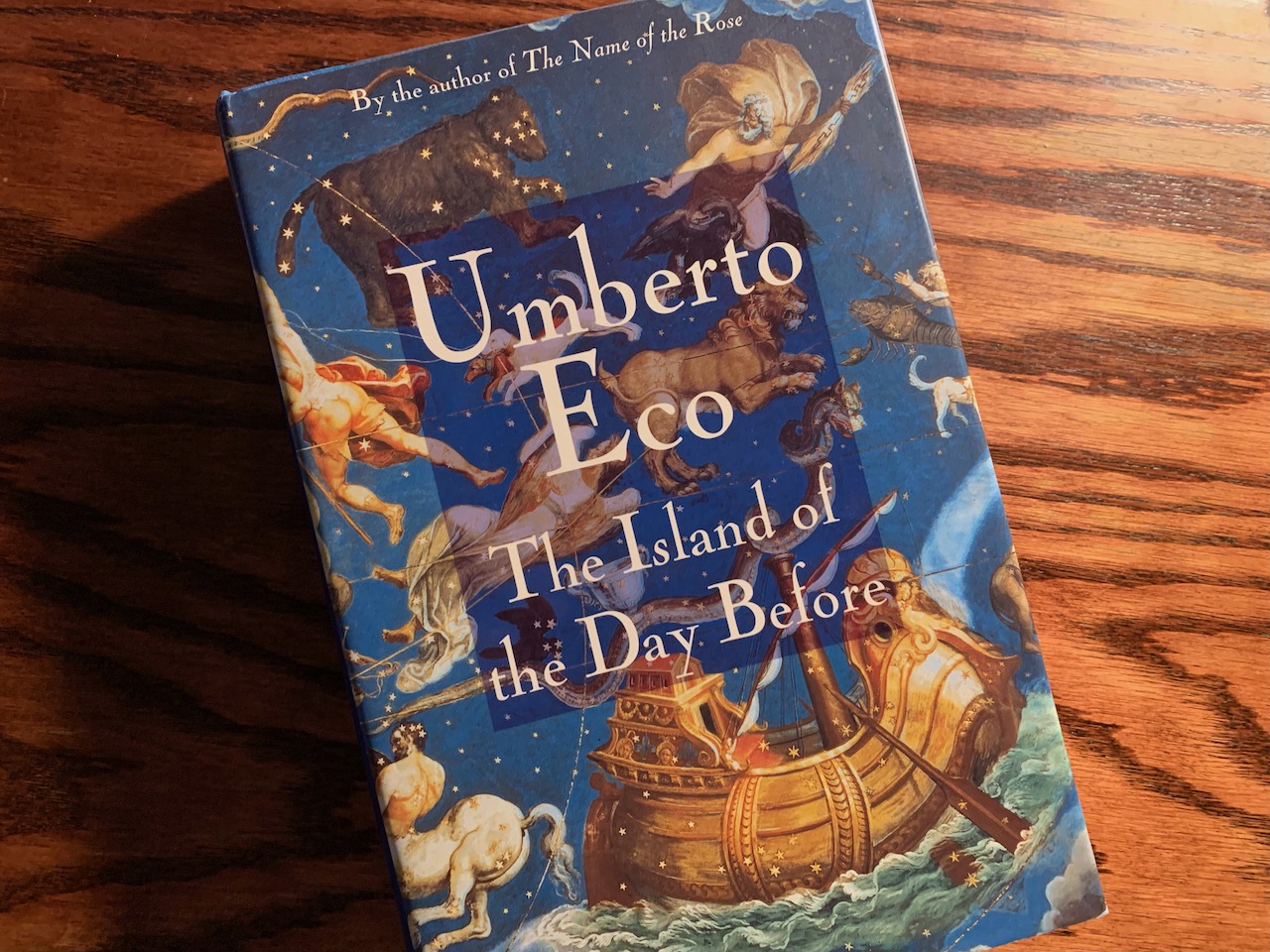
The Island of the Day Before, by Umberto Eco


[3 out of 5 stars]

I enjoyed the first two thirds of this book immensely, so much so that I was prepared for a time to give it 5 stars. Compared to Eco’s other novels I have read (especially Foucault’s Pendulum, which is exceedingly dark), this one is overwhelmingly filled with brilliant luminosity: sunlight, tropical seas, starry expanses, and poetic reverie. Eco’s strengths as a masterful writer – his ability to coin memorable phrases and to turn the page into a canvas filled with richly compelling and imaginative verbal imagery – are on display here as much as ever, and are indeed a source of much fascination and delight. As a philosopher, historian, and literary scholar, his encyclopedic weaving of threads and themes from virtually all across creation, interacting with them most playfully all the while, is likewise once again a standard feature. He manages to touch upon philosophy (especially Desartes), science (astronomy/cosmology, botany, ornithology, psychology), religion and theology (e.g. creationism vs. some form of materialism/evolution; predestination and free will; The Song of Solomon), history (the obscure and complicated machinations of European politics of the 1600s, in southern France and northern Italy most especially, figure heavily into this story, and at least two historical figures, the Cardinals Richelieu and Mazarin, are featured as minor characters), linguistics, poetry (especially the significance of metaphor; John Donne and the Metaphysical Poets get many nods), navigation, timekeeping, and much more during the course of these 500-plus pages, all filtered through the lens of seventeenth century European society and its concerns and obsessions. (With regard to the sciences and to timekeeping, the overarching plot device involves the quest for the discovery of a reliable means for calculating longitude. As a prerequisite for comprehending much of what is going on in that regard, this book, also published around the same time as this novel, is highly recommended.)

A parade of vividly rendered characters come and go, most memorably: Pozzo (the protagonist’s colorful father, whose abrupt demise sets up a recurring theme of sudden death and irresolution), Padre Emanuel (a fatherly priest who has constructed an elaborate machine for systematically generating and cataloging metaphors), Monsieur Saint-Savin (swashbuckling courtier and provocative religious skeptic, modeled upon Cyrano de Bergerac), and Father Caspar (an eccentric elderly Dutchman of the Jesuit order who is also an astronomer, inventor, and would be apologist for Scriptural literalism in the face of ascendant scientific skepticism). Overarching themes explored (also recurring to some extent in Eco’s other novels) include the blurred boundaries between science and superstition and between imaginative brilliance and delusional madness. Regarding the former pairing: we children of the Enlightenment think of these as polar opposites, as diametrically-opposed – and irreconcilable – as east and west, but Eco, with clever subtlety, calls this assumption into question with considerable effectiveness. The distinctions between, say, astrology and astronomy or alchemy and chemistry, were not at all clear prior to the seventeenth century. Nor are they nearly as clear today as we would like to pretend. Consider that Newton disliked his own Theory of Gravitation because it involved the “myth” of bodies acting upon one another from a distance, which smacked of a reversion back to some sort of Dark Age sorcery. But (Einstein’s Theory of Relativity notwithstanding) we’re still stuck with it today as the most reliable explanation available – one which satisfactorily explains the observed phenomena while enabling us to successfully navigate interplanetary space. And upon further reflection, in this light, should the fact that serious experiments were conducted by rational men in the seventeenth century involving things such as the Powder of Sympathy really strike us as utterly ridiculous?

* * * * * SPOILER ALERT ! * * * * *

My primary complaint against Eco here involves his use – or, more properly, misuse – of the narrative arc and expectations pertaining thereunto. This is not altogether unique to this novel. Eco likes to mess with his readers. For example, he reportedly gave a deliberately slow start to his debut (and most famous) novel, The Name of the Rose, not only as a metaphorical representation of what the two main characters are experiencing at the beginning of the story, as they perform the arduous ascent up to the mountaintop monastery which serves as the tale’s setting, but also as a means of “sloughing off” readers of a more lazy disposition, whom he considered unworthy of what he had in store. But that kind of tinkering is more than forgivable when it occurs early in the book, involves only a chapter or two, and has adequate justification. About two thirds of the way through The Island of the Day Before (after the presumed death of Father Caspar in Chapter 25 and the lengthy meditation on the meaning of doves in Chapter 26 – the last truly delightful extended passage in the book, in my opinion), I began to suspect that the reader was being set up, and that Eco had no intention of bringing this story to anything resembling a remotely satisfying resolution. And in this suspicion, I was, regrettably, proved correct. Again, Foucault’s Pendulum also features a conclusion which presents way more questions than answers, but it all seems even more pronounced and less forgivable here, if only in the spirit of “fool me once…” and for no other reason.

But there are other reasons. The last chapter of the book involves some extended riffing on Donne’s poem A Valediction: Forbidding Mourning. I grant that it’s kind of clever, on the one hand, but it also feels a bit . . . overdone. (Heh, see what I did there?) At any rate, it’s definitely not worth the high price paid (in terms of pages) to arrive at such an underwhelming destination. It also makes me wonder: if the rest of the 500-plus page book (or at least the latter third, which, as mentioned, has far fewer memorable passages and on the whole has the feel of a rather disjointed ramble among one speculative excursus after another) was conceived largely as an excuse for a gradual convergence upon this very odd concluding conceit, it seems a rather inconsiderate joke to have played upon the reader. This one, at least, found it difficult to laugh.

UPDATE, SEPTEMBER, 2025:
I must say that this book has grown on me considerably since originally posting this review. In the intervening time (a couple of years) I find my mind returning to certain portions of it periodically, and more favorably each time. Most of what I say above still holds true, and I’m not going to change the star rating, but it’s definitely a “strong” three stars – and absolutely worth reading.

Thursday, May 26, 2016

Foucault’s Pendulum, by Umberto Eco


Eco is a brilliant writer and an encyclopedic mastermind who somehow manages to touch upon almost everything in the course of spinning his tale. As far as that goes, lovers of The Name of the Rose will not be disappointed with this one either: there is much here to marvel at and to ponder over, and, even at an excess of 600 pages, it grabs the reader’s fascination early on and doesn’t loosen its grip throughout. (The fact that it is divided into 120 – not an arbitrary number, to be sure – bite-sized chapters is a big help in that regard.)

But the occultism (including grotesque allusions to child sacrifice, forays into animistic voodoo, and such) gets pretty thick at times, leaving a reader with any properly-oriented spiritual sensibilities feeling like they need a good shower. And at some point, the astute reader will become aware of the fact that, just as the protagonists in the story are playing an elaborate game, piecing together disparate facts, clues, and associations to construct an intricately woven and (almost) convincing metanarrative, the author is playing a similar game with his readers. Ambiguity, uncertainty, irresolution, and doubt are precisely the point, to a large extent, but the end-game appears to be to elicit a resigned acknowledgement that there ultimately can be no metanarratives – though we desperately want there to be – and all attempts at imposing meaning on the meaningless cosmos amount to the deluded ravings of self-emaciated and bug-eyed conspiracy theorists. In the face of ultimate and inevitable meaninglessness and encroaching despair, simply put it all out of mind and enjoy the beauty that presents itself to you at the given moment.

Well, nice try, Umberto, but as well written, ingeniously devised, and (at times) fun your own elaborate literary conspiracy theory is, I’m not buying it.

My singular attempt at insightful literary observation regarding this work: just as each Canto of Dante’s Divine Comedy ends with the same word, “stelle” (“stars”), several of the ten major sections of this book, including the very last, end with a line containing the word “beautiful” or “beauty,” or with some simple expression of incidental beauty experienced or observed. (Beauty and symbolism are paramount themes in Eco's works, both fiction and non-fiction.)

A couple of gems definitely worth holding onto:

“I believe that what we become depends on what our fathers teach us at odd moments, when they aren’t trying to teach us. We are formed by little scraps of wisdom.”

“And someone else—was it Chesterton?—said that when men stop believing in God, it isn’t that they then believe in nothing: they believe in everything.”

Wednesday, January 4, 2012

Chesterton and Calvinism


Having posted on G. K. Chesterton’s Orthodoxy here before, I thought this insight from John Piper to be right on the money and worth sharing. No doubt there were folks who went by the appellation of “Calvinist” in Chesteron’s own day who were cranks, just as there are today. Notwithstanding, failure to distinguish the straw man or the caricature from the genuine article is a fault that even the most brilliant of men can commit. In Chesterton’s case, it is a most forgivable one.

Monday, April 25, 2011

Barry Moser and The Pennyroyal Caxton Bible


At some point during my work on the HCSB Study Bible I became aware of this awe-inspiring project by master illustrator Barry Moser (with some help from other luminaries, such as renowned typographer Matthew Carter). As the prospectus claims, The Pennyroyal Caxton Bible is probably the most significant edition of a fully-illustrated Bible since that of Gustave Doré, in the mid-nineteenth century.

Working in a medium called Resingrave, Moser produced a vast series of black and white images to accompany the biblical text that are arresting in their graphic intensity. Considered on the whole, their undeniable beauty is offset by a jarring—sometimes even disturbing—coarseness and realism. The images range from the nearly abstract, to the poetically symbolic, to the indelibly human, and the work manages to exude, at the same time, a sort of timeless grandeur and an immediacy that is strikingly contemporary.

Another thing to appreciate is that, despite its lofty aspirations, this really is an edition of the Bible designed with reading in mind. The text of the Authorized/KJV translation is set in double columns with subheads to mark each chapter, but without verse notations, paragraph breaks or indents (pilcrows are employed instead) and italic type (used in most AV editions to denote words not present in the original text) to impede smooth and fluid reading.

I wish that I could convince someone, among the very few individuals I know who might actually possess the means coupled with the inclination, to invest in a Primary or Deluxe edition, so that I might have the borrowed privilege of perusing such an exquisite masterpiece of printing and binding. For those of us who don't have ten (for the Primary) or thirty grand (for the Deluxe) to spare, there is a reasonably priced, single-volume facsimile edition available in both hardcover and perfect-bound paperback. I ordered the latter a few weeks ago and was delighted to discover that the large format (8.25" x 11.812") faithfully replicates the text and illustrations at their original size. Only slightly disappointing is the fact that the margins are trimmed in a bit, so you don't quite get the benefit of the generous white space and luxurious page proportions of the original, which are a historical feature of Bibles and other “showcase” bound texts ever since the age of illuminated manuscripts, but given the need to economize that’s understandable, I suppose.

One slight word of caution to those who might consider a purchase: as alluded to above, several of the images are at least a bit disturbing and some might be said to push the boundaries of propriety. (One image depicts a woman kissing the feet of the crucified Christ, and possibly gulping blood flowing off of his toes.) There is a good deal of nudity depicted as well, though I would’t characterize any of it as gratuitous. Just take that into consideration—at any rate, it’s still a worhwhile addition to your library, in my opinion, and a very notable artistic endeavor.

Tuesday, April 12, 2011

Chestertonian Musings, Part One


Recently, I actually got around to reading G. K. Chesterton’s Orthodoxy, which has been on my “to read” list since time out of mind. As I suspected, I found that I’ve had considerable exposure already to direct quotations of various passages (particularly Chapter Four: The Ethics of Elfland) or have absorbed many of his ideas by osmosis, via my reading of others who were thinking his thoughts after him. At any rate, it was very enjoyable and refreshing to get to absorb these notions in their original context of Chesterton’s masterful and brilliant prose.

There were strains of Chesterton’s thought, however, that I, with a mixture of delight and dismay, discovered that I was encountering for the very first time. Most memorably, in Chapter Six: The Paradoxes of Christianity, I was enthralled to find a brilliant articulation of a notion that has crept in upon my own consciousness over the last several years, but which I have never really attempted to explain or put into words. In that chapter’s introductory paragraph, Chesterton writes:

The real trouble with this world of ours is not that it is an unreasonable world, nor even that it is a reasonable one. The commonest kind of trouble is that it is nearly reasonable, but not quite. Life is not an illogicality; yet it is a trap for logicians. It looks just a little more mathematical and regular than it is; its exactitude is obvious, but its inexactitude is hidden; its wildness lies in wait.

As a visual artists who dabbles in other disciplines, this whole idea resonates with me very deeply. Indulge me here in a brief and somewhat random excursus:

Is it not very odd, for instance, that shapes so fundamental as the square and the circle, which can be drawn with exactitude using a ruler and/or compass, defy precise mathematical definition and analysis (at least when one takes the very first steps in trying to peel them apart)? I’m referring to the fact that &pi (3.142…), the ratio of a circle’s diameter to its circumference, is an irrational number, one that cannot be expressed as a ratio of two whole numbers, no matter how large. The same goes for √2 (1.414…), which is the ratio between one of a square’s sides and a diagonal drawn between opposing corners. Other very important—and naturally prevalent—numbers have the same slippery characteristics: &phi (the “golden section”, or .618…), and √5 (2.236…), to cite two additional examples. The point is this: I encounter and use things like circles and squares all the time. How can something so basic, simple and ubiquitous be, at the same time, so downright elusive and mystifying—so irrational?

This stubborn refusal of the natural order to be brought into perfect conformity with nice and tidy logical definitions drove some of the ancient Greeks to the point of maddened distraction (the Pythagoreans). But the eventual acquiescence on the part of some to this paradox yielded some real aesthetic triumphs, such as the Parthenon, whose subtle and deceptive entasis and unevenly spaced columns testify to the awareness that a bit of carefully employed non-conformity here and there proves more satisfying than strict adherence to mathematical and logical notions of orderliness and “perfection”.

I think I will have to further explore some of the rambling rabbit trails this topic tends to generate in some additional posts, hence the “Part One” label above. Let me just wrap this one up by expressing my delight in discovering that Chesterton, who possessed a mind and a soul (to say nothing of a body!) far broader and deeper than my own, also acknowledged, exulted in, and reveled in this same phenomenon—and also felt within it the same spur towards faith that I feel. While this hardly constitutes some objective proof of the existence of God, I, like Chesterton, detect an audible echo of the Divine in these things—and a decidedly Trinitarian echo, at that.

Monday, December 28, 2009

The Flying Islands of the Night


A few weeks before Christmas, I was reading up online regarding Franklin Booth, one of my hero illustrators. Almost as an afterthought, I decided to check ebay to see if anything associated with Booth might be available. Boy, was I ever not disappointed! It turned out that there were a couple of copies of this rare gem about to go for what seemed to be really bargain prices. I immediately jumped into the bidding for one of them (the better of the two) and actually won it—and for considerably less than I was willing to offer as a final bid! So of course, what did I do? When it came in the mail, I gave the package to my wife unopened and told her that she could save herself any further trouble: just wrap this and put it under the tree for me, thank you very much. Christmas Day having come and gone, I’ve certainly been enjoying my newly acquired jewel of a book for the past few days, which indeed arrived in remarkable condition for its near one-hundred-year-old age. (It even has an intact dust jacket!)


The Flying Islands of the Night is a fantastical three-act play in verse by James Whitcomb Riley, an American writer and poet whose mostly humorous and sentimental verse received notable attention and acclaim in the late nineteenth and early twentieth centuries. Two or three editions of the book had already been published when, in 1913, The Bobbs-Merrill Company put out an exquisite new edition with illustrations by Franklin Booth, a rising luminary in what would prove to be illustration’s Golden Age, and a fellow native, along with Riley, of Indiana. This edition solidified Booth’s reputation as a first-rate illustrator and also, in all probability, rescued this work of Riley’s from complete obscurity. For as far as literary merits go, the work itself is perhaps only slightly better than mediocre. The story indeed contains some imaginative embellishments, but manages to be rather undramatic and predictable on the whole. Riley’s verse, for all to which it aspires, meanders in realms of obscure tediousness for much of the time, with lurching outbursts of real brilliance here and there. (The better portions achieve an almost Chestertonian caliber.)


But again, it is Booth’s illustrations which really make this book. Booth is known primarily for his richly detailed and masterfully composed pen and ink drawings. These were featured in some books, but even more notably as spot illustrations for stories and as full-page advertisements in magazines such as Scribner’s, Good Housekeeping and National Geographic in the early twentieth century. His pen is in evidence here (albeit in comparatively subdued presentation) on the end sheets and title pages, but The Flying Islands of the Night is the most celebrated example of his work in color, executed with what appears to be a combined technique of pen and watercolor. Sixteen such color plates, tipped in on heavier, off-color stock and covered with a sheet of vellum (onto which one or two lines of the appertaining verse are printed in brown ink), embellish the story throughout. Booth’s rich imagination, his penchant for soaring compositions, his sumptuous use of “negative” space, and his love of pattern—all typical features of his work in both black-and-white and color, are on full display in each of these. Just a few more representative examples:


Saturday, November 21, 2009

The Power of Limits


I checked this out from the library thinking that I would probably just skim it, but I got so engrossed in it that I read the whole thing. The topic is one of perpetual fascination to me, perhaps bordering on a minor obsession: the pervasiveness of certain geometric patterns and harmonious mathematical relationships all throughout the created order, and most specifically, the relationship known as the golden ratio, or .618…. This unique and remarkable ratio manifests itself virtually everywhere one turns, in created works of both Divine and human origin: spiral galaxies, hurricanes, sunflowers, the chambered nautilus, the human hand and ear, notable works of architecture and graphic design, ancient Greek pottery, paintings by the likes of DaVinci and Seurat, musical harmonies, and a Boeing 747, all just for starters.

No book could possibly be said to cover the topic exhaustively, but this is one of the more thorough treatments I’ve encountered on the subject. It explores numerous examples of this sort of thing which I had never even begun to consider. There are really fine illustrations and diagrams (many of them quite intricate, detailed and beautiful) on every page. So, in terms of a surface-level analysis of the phenomena, this book is superb.

What I find much less satisfying, however, are the author's attempts, interwoven with increasing emphasis as the chapters progress, to discover what this all means on a deeper, spiritual level. Though he never articulates such a position explicitly, it seems that he would probably be on good terms with what has since become the Intelligent Design movement. (This book was originally published in 1981.) As a Christian however, I am firmly convinced that the doctrine of a personal, Trinitarian Deity is the most obvious point of convergence for all the universally imbedded testimonies to intertwined unity and diversity which this book is dedicated to exploring. Though not really surprising, it is nonetheless disappointing to see this conclusion ignored by the author in favor of an unsatisfying and impersonal hodgepodge of eastern dualism, mysticism, and vaguely beneficent evolutionary principles. (That last point is especially a very interesting notion, one which I think would be most difficult to harmonize with Darwin’s theory of natural selection.) At any rate, had the author been able to rise above all this, I might have given the book at least four (out of five) stars.

Sunday, September 13, 2009

Economics in One Lesson


Economics is one of those topics on which I've intended to get better educated for some time now. The events since the latter half of '08 have definitely bumped that intention up several notches in my list of priorities. The first problem I really had to tackle was figuring out where to start, which is to say, deciding exactly what and whom I should be reading. I knew just enough to determine that pretty much anything from a Keynesian perspective—which, with differences that are in the final analysis inconsequential, has represented the mainstream positions of both the political right and left for the last several generations—was out. Also out was any nonsense coming out of the far left, i.e. socialism or fascism, unfortunately including a number of Christian writers who have adopted these positions and labored to make them somehow compatible with their Faith.

Eventually I found out about the Austrian School Economists, generally liked what I was hearing from that perspective (with important qualifications noted below) and decided to dive in by first tackling Henry Hazlitt's (1894-1993) well lauded primer Economics in One Lesson. Turns out that it was a great choice. Who would have ever thought that a book on economics could be a page turner on par with an Agatha Christie novel? Far from seeming stale or out of date (the volume was first published in 1946 and last updated by the author in 1979), the material is immanently relevant given our current state of affairs, and delightfully readable to boot. I started off underlining what I thought were key sentences from the Prologue and Chapter One, and then gave up when I realized that the whole thing needed underlining! (Just read the first two-and-a-half pages from Chapter One on Amazon and you will see what I'm talking about.)

Hazlitt's thesis statement, for which the book as a whole is simply a cyclical reiteration is as follows:

…the whole of economics can be reduced to a single lesson, and that lesson can be reduced to a single sentence. The art of economics consists in looking not merely at the immediate but at the longer effects of any act or policy; it consists in tracing the consequences of that policy not merely for one group but for all groups.(p17)

In each chapter of the book, Hazlitt re-illustrates this fundamental principle by applying it to matters such as government subsidies, government attempts at manipulating supply and demand via price fixing, controls on imports and exports (including tariffs), rent controls, minimum wage laws, inflation, and a number of other all too familiar phenomena.

To sum up, I really enjoyed and profited from this book, and plan to read further on this topic from other writers of the Austrian School. That said, I don't want to hold forth a generally glowing review without acknowledging that these guys do have their own blind spots and that those are not insignificant. As a Christian, I am bound to affirm that the fear of the Lord is the beginning of all knowledge and wisdom (Proverbs 1:7; 9:10; 15:33). That includes wisdom and knowledge in the area of economics. Through the mechanism of common grace, I believe that the Austrian Economists are generally right-on in their astute observations of how the economic aspect of the world works and are generally far less deluded than other competing schools of thought on the matter. However, their essentially secular viewpoint does leave them open to certain deceptions and shortcomings, the chief of these being the fundamental assumption that man is basically good and that his greatest problem is not sin but ignorance. In addition, I must also bear witness that true and enduring freedom and liberty—in all their various forms, including economic—are blessings that are only found in Jesus Christ. Any attempts to idolize individual freedom and liberty by abstracting them and attempting to construct a comprehensive worldview around them (e.g. Ayn Rand, a noted favorite of both the Austrian Economists and their Libertarian political chums) is just as much doomed to frustration, failure and wretchedness as any other false ideology.

Tuesday, August 4, 2009

Colligo, Ergo Designo


I’ve been casually thumbing my way through Instant Graphics, an inspiring look at the creative processes of other designers, particularly those whose work relies heavily upon collage and the appropriation of clip art, found objects, ephemera, etc. One of the recurring themes brought out in this book is how people who are designers also tend to be avid collectors—collectors even (especially?) of things that many other people would deem “junk”.

Many designers and illustrators are explorers and archivists of their immediate environments, scouring the city streets, parks, river banks, gardens, markets, and even their own studios, for objects, textures, and source material…many designers inevitably find themselves becoming collectors and/or curators of certain types of imagery or objects—insects, sports cards, magazine clippings, old catalogs, engravings, or prints. Some develop a fascination with a specific type of image or object—perhaps from an accidental find—and set about actively researching and building collections of them, which, in turn, begin to influence their subsequent work. —p24

Sean Adams, of AdamsMorioka, has the following to say:
“I have never met a designer who is not a closet collector of something. Whether it’s thimbles, Japanese packaging, or rocks, everyone has one collection. Being a collector is just like being a designer; you don’t choose to be a designer, it chooses you.”—p98

As one who can certainly identify with this, I am driven to muse: do we become designers because we are obsessive collectors?…or is the impulse to collect driven by one’s work as a designer?…or is it all a vicious cycle with no beginning or end? I confess to being a collector of books, magazines (most notably National Geographic), newspapers, LP records, old photographs, letters, documents, postcards and correspondences, wine bottles, timepieces, posters, maps, prints, 8mm film and projectors, old shoes, spent rounds of ammunition, currency and coins, fragments of flooring, windows, hardware, masonry and woodwork culled from old buildings and other structures, samples of nature (flowers, leaves, bark, nuts, bones, feathers, dead cicadas, turtle shells, sea shells, and rocks), drawings that my kids have made, nautical and/or astronomical paraphernalia, and anything having to do with trains.

How about you? What collections do you keep? Or perhaps I should ask, what collections keep you?

Sunday, July 5, 2009

Modern Art and the Death of a Culture


Originally published almost forty years ago, this work has certainly lost none of its relevance for those seeking an understanding of the forces behind the downward trajectory of both western art and western culture over the course of the last three centuries or so. This assertion in itself might seem a rather odd one to most folks—didn’t the problems (for both art and culture) really start during the 20th century? Actually, no.

Rookmaaker argues quite persuasively that the seeds of nihilism and despair were actually sown during the “Enlightenment” period of the 18th century and the obvious problems which began to manifest themselves in the 20th century were the resultant harvest. The intervening 19th century may be viewed as a period during which these matters were working themselves out and during which much art that might be deemed “beautiful” was still being produced, but the problems were there nonetheless, and with increasing clarity, as a mere scratch to the surface reveals.

Beginning in medias res, with the medieval period (it isn’t really necessary to go back further in time to prove his point), Rookmaaker demonstrates that there was a time when physical and spiritual realities coexisted comfortably and formed a seamless whole, both in the thoughts and lives of people and on the painted canvas. This view persisted, remarkably in some respects, even through the Renaissance and Reformation periods.

It was the Enlightenment, with its dogged insistence upon rationality and empiricism as the only standards for gauging “reality”, which drove the seemingly irrevocable wedge between the natural and the supernatural. Artists (and everyone else, for that matter) since that time have come under increasing pressure to choose between the two. The predominant approach has been to reject the latter in favor of the former, resulting in a growing crescendo of meaninglessness and despondency. Certain movements (Romanticism and certain enclaves of Christian art) have sought the opposite approach of asserting the supernatural over the natural, but with limited success, largely because at heart they have continued to accept the fundamental dualism of the Enlightenment view.

My only reason for not rating the book more highly is that, although Rookmaaker’s insights are keen, I find his style a bit exacting, and the increasingly depressing nature of the material begins to weigh down on you after a while. (I actually started this book a good while back and had to take an extended break about two-thirds of the way through before finishing.) There’s great stuff toward the end though, so don’t fail to persevere if you encounter the same difficulties!

Saturday, March 28, 2009

That Hideous Strength


This is a very relevant book for our times. It’s also C.S. Lewis. Those two factors alone make it a more-or-less mandatory read – and one that is virtually guaranteed to be above average, at least. I do have to say, however, that I did not find it nearly so enjoyable to read as Lewis’ very best fiction (which would be Perelandra and Till We Have Faces, in my opinion).

While I embrace with satisfaction the overall trajectory of the narrative – cold, calculating rationalistic-materialism on the one hand effectively contrasted with enthralling, incarnate (and erotically charged) spirituality on the other – I do have to admit that I somehow found the ending rather anti-climactic. In addition, there are a number of elements here and there which I found quite puzzling and disjointed. (For just one example, what’s up with that one little segment of first person narrative in Chapter One which is never again taken up?) Perhaps some of this apparent lack of cohesion is by design, I don’t know. Lewis was a very clever one.

On the plus side, the book is chock-full of very interesting characters, some great individual scenes and is deliciously rich in irony. At times the satire (it took a while, but I eventually began to see why many reviewers describe the work as “satirical”) approaches laugh-out-loud intensity. So it really is a very good book. Probably the biggest thing working against it is that it follows right on the heels of Perelandra, which is positively sublime.