Showing posts with label Film. Show all posts

Monday, October 8, 2012

Anonymous


Though it has received decidedly less notoriety and far fewer accolades, Anonymous is nonetheless for lovers of Shakespeare what Amadeus is for lovers of Mozart. That is to say, its strength lies not in historical or biographical accuracy, but rather in the delightful way that it highlights the wonder and fascination that are evoked by the subject’s body of work.

Utilizing the foundational premise (a rather hotly contested minority position within the academic community) that the historical William Shakespeare did not produce (indeed, could not have produced) the works that have been attributed to his name and that they come to us instead from the pen of his contemporary, Elizabethan courtier Edward de Vere, 17th Earl of Oxford, this film layers on a good deal of highly-conjectured though artfully contrived what-if-ing to present one possible (to use the term liberally) scenario that might account for this mother of all literary misattributions. Is the proposed scenario a plausible one? On the whole, hardly—no more so than the assertion that it was Salieri who commissioned Mozart’s Requiem Mass, or that he actually murdered (or at least attempted to murder) his infinitely more talented rival. But let’s remember first of all that Shakespeare himself (whoever he was) took a good deal of historical license in his own plays, for the sake of—shall we call it—“dramatic enhancement”, so why should any cinematic treatment of his life necessarily be judged by a higher standard?

Let me get just a few caveats out of the way at the beginning:

If you’re not freshly read-up on all the movers and shakers of the day, both literary and political—and possibly even if you are—the rather constant flash-back/flash-forward interplay that is the film’s dominant modus operandi will likely prove to be somewhat bewildering.

The Puritans are typically and rather unnecessarily slandered, maligned, and misrepresented. Others have set that record straight quite effectively, so I won’t bother to get into it here. (Although I do have to point out that, ironically, while it would be a stretch to classify the historical Cecils as Puritans, a Puritan connection of some sorts between Shakespeare/de Vere has been proposed.)

The licenses taken with reality occasionally approach the absurd. These would include the presentation of the Tudor Rose as an actual flower (the simultaneously red and white rose is a purely heraldic device), and the idea the Queen Elizabeth’s funeral procession took place on the frozen Thames River. (No doubt the latter was contrived by director Roland Emmerich simply because it would provide opportunity for a few seconds of some way-cool CGI footage. And, admittedly, it does, but he should have saved that for a much-needed screen adaptation of Tim Powers’ Anubis Gates, which I read for the first time just this past summer. After seeing this film I think he might be a really good candidate to pull that off, but I digress…) And then of course, there’s the big whopper of a “revelation” towards the end—the most brazen conjecture of them all in a film packed full of them. I won’t give it away, but let’s just say it will definitely color any subsequent re-viewings.

But those flaws duly noted, the strengths of this film are considerable: There are some really fine performances by just about everyone involved. The sets and costumes are superb. (De Vere's study is a source of fascination in itself.) The footage is generously but tastefully interspersed (in my opinion) with some really beautiful and convincing CGI depictions of Elizabethan London. We are treated to some extraordinary and compelling re-creations of Shakespearean theatre as imagined in the intimacy of its original setting. Several of The Bard’s plays are given this treatment, most prominently Henry V, one of my personal faves, and the presentations are quite stirring.

And this last point leads me to say that, if at any point the film approaches genius, it is in allowing all of the intrigue to serve as a decorative frame for the art itself. It is the plays and poems themselves, as well as the emotions they inevitably conjure up in others—wonder, delight, awe, rapture, jealousy—that assume and retain center stage, leaving all questions as to their authorship to fade silently into the wings. And most importantly, this film provides potent affirmation that art and artistry vastly overshadow politics as long-term molders of human society, the latter fading to mere incidental importance with the passing of time. As this film’s version of Ben Jonson so memorably reminds us:

“My lady, you, your family, even I, even Queen Elizabeth herself will be remembered solely because we had the honor to live whilst your husband put ink to paper.”

Sunday, July 8, 2012

The “Soap Opera Effect” and the Tenacious Power of Associations


I’m sure this is really old news for all of my friends involved in film or video production, and I'm pretty sure that I had read or heard about it somewhere myself previously, but I had my first-ever first-hand experience with it this afternoon, and it was pretty startling.


We were visiting my in-laws, who just got a new HDTV (my own family is still stuck in the 20th century in this regard), and one of the Harry Potter movies was being broadcast on network TV. After maybe 60 seconds of viewing I began saying out loud “Why do I feel like I’m watching a soap opera?” I pulled out my iPhone and started to Google, and, sure enough, the string “new tv soap opera effect” popped up by the time I had keyed in the first three words. This article explains what’s going on quite effectively. Long story short, for at least the past 40 years or so, most made-for-TV productions have, for reasons of cost-effectiveness, been shot on video rather than film. The effective frames-per-second rate for video is typically twice that of the long-established standard for film: 60fps for video vs. 30fps for film. (Actually, the standard is 24fps for film, but without getting too technical, a fairly insignificant conversion up to an effective rate of 30fps has been standard practice for decades when converting celluloid for TV/video presentation.) Modern HDTVs typically come with a default setting (which can usually be tweaked or disabled altogether via a little bit of digging through the menu options) which impose an effective rate of 60fps (or even greater in some cases) on everything.


These facts make for a fascinating case study of technological irony and the durability, for better or for worse — in this case almost certainly worse — of subliminal associations. The irony stems from the fact that, while objectively it’s an undisputed fact that 60fps results in much more fluid and life-like moving imagery (especially great for sports viewing), the overall cheaper production values generally associated with TV/video as compared to film are likely to cause a viscerally negative reaction from viewers when they encounter something that they know is supposed to be in the latter category but which has been translated into the former. It just immediately looks and feels wrong. Really wrong.


I would hypothesize (someone’s probably done a doctoral dissertation on the subject already, and I’m sure there’s plenty more to read online, but I haven’t bothered to delve any further yet) that the above holds true for folks who are roughly my age and older, who grew up with a sharp line of demarcation between TV and film, but falls off rapidly among younger viewers. Indeed, my thirteen-year-old son was able to acknowledge the difference, but still favored the 60fps/120hz setting anyway. And with the transition of the film industry to digital technology really picking up steam in recent years, it’s a sure bet that directors and producers will be less and less willing to be tied down to an arbitrarily lower standard of visual quality, imposed only by the expectations of “old fogey” viewers like myself — nor am I necessarily arguing that they should be, various factors being more-or-less equal. But the transition is definitely going to take some getting used to for us old-timers. Case in point: all you Tolkien fans better brace yourselves, because this will factor into Peter Jackson’s production of The Hobbit, set for release this coming December, in a big way.

Saturday, March 17, 2012

The Secret of Kells


Today being St. Patrick’s Day, I’m reminded of a plug I meant to give for a movie I saw for the first time a few weeks ago. The Secret of Kells is a delightfully animated film which involves a fictional story (populated by some quasi-historical characters) about the creation (and preservation) of the famed Book of Kells. The animation style is refreshingly and uniquely stylized in a way that pays homage to the artistry of the text around which it revolves.


As a rather interesting aside which I was unaware of prior to watching the film, a tall central siege tower, as is prominently featured in the movie, was indeed a feature of the Abbey of Kells, and possibly of other Celtic monasteries of the period. As my pastor pointed out to me in a conversation about the film, this fact lends a new dimension to these lines from the well-known Irish hymn Be Thou My Vision.

Be thou my breastplate, sword for the fight;
Be thou my dignity, thou my delight;
Thou my soul’s shelter, thou my high tower:
Raise thou me heavenward, O Power of my power.

Saturday, July 30, 2011

Fire and Water, Nature and Grace


I just saw Terence Melick’s much-talked-about film The Tree of Life this past week. More like cinematic poetry or an art house film than a typical mainstream movie, it is both euphorically beautiful and intensely thought provoking. Above all, it portrays a creation that is super-charged with wonder, and spends much of its two-and-a-half hour length inviting us simply to bask in that wonder in true Chestertonian spirit.

There are so many avenues worth exploring and commenting on. (My friend Brian McLain has some keen insights, especially regarding the film’s reliance upon the viewer’s own participation via his or her own subjective experiences, relationships, and memories, which I commend to you.) Perhaps I will get around to surveying some of those other perspectives as well, but for now I want to start at the shallow end and speak to those aspects that I feel most qualified to deal with, which have to do with the nature of some of the visual symbolism engaged in the film.

First of all, with the noted exception of the evolutionary framework employed (though even that is intriguingly toyed with, raising some issues that I will shelve for later discussion, perhaps) the symbolism that Melick employs is pervasively and explicitly Christian and scriptural. The film opens with a quotation from the Book of Job, Chapter 38:

Where were you when I laid the earth’s foundation...while the morning stars sang together and all the sons of God shouted for joy?

The themes of Job resurface again and again as the narrative unfolds, and there is also a very early and explicit reference to the tension between “Nature” and “Grace”. Taken simply at face value, this is obvious and potent enough. However, I think it also helps to reflect that within the Christian tradition, this fundamental dichotomy (at times pushed to dualistic extremes) has gone by a number of other names, at least some of which I think there is good reason to believe that Melick is also intending to conjure up at various points. These would include, but are by no means limited to: Law vs. Grace, Justice vs. Mercy, Righteousness vs. Sinfulness, Love vs. Judgement, Forgiveness vs. Discipline and/or Punishment, Free Will vs. Predestination, Salvation vs. Damnation, Flesh vs. Spirit.

Visually speaking, two of the most recurring images employed in The Tree of Life are fire and water. It’s really essential to have a self-conscious grasp of the biblical associations of these two metaphors in order to adequately appreciate how Melick employs them throughout his own work here. To give a brief biblical catalog: Water is primordial (Genesis 1:2). It is mysterious (due, at least in part, to its hidden depths and to its elusive, undulating motions). Water is most often associated with its life-granting and regenerative qualities—with birth and with re-birth, but it also has to be remembered that it can easily be turned into a threatening instrument of judgement and destruction. When contrasted with dry land, for instance, it often represents the forces of wickedness threatening to submerge and wipe out the people of God (Isaiah 8:7-8). Fire likewise is thought of first and foremost as an element of judgement, condemnation, and ruination, which it certainly is. But fire is also associated with holiness, and with testing and purification (Exodus 3:1-6, Isaiah 6:1-7, Psalm 12:6). Following this line, its implementation is often towards radically transformational as opposed to purely destructive ends (II Kings 2:11, Malachi 3:1-4, II Peter 3:5-13). Significantly, both water and fire are associated with the Holy Spirit. (Bird images are as well, which is also worth noting with respect to Melick’s film.)

As should already be apparent by this point, it is essential to consider that the relationship between these two “elements” and their various associations is not one of pure or simple antithesis, but rather, the antithesis is dynamic and complicated—wondrously so. To illustrate this point, let me turn to the work of another visual artist who explored these same themes to great effect in his own work: the nineteenth century landscape painter Frederic Edwin Church. (Gene Edward Veith offers an excellent critique of Church and the other prominent painters of the Hudson River School in his book Painters of Faith, and I owe the following observations to him.) I was reminded a number of times during The Tree of Life of Church’s painting Cotopaxi.


Here we have fire: the volcano, the smoky ash cloud, the sunset, and the eerily glowing foothills. We also have water: the waterfall, obviously, but also (possibly) the cool tones of the sky (the waters above the firmament) in the extreme background. Interestingly, the two elements intermingle in the mid-ground, as the fiery sun is reflected in the lake behind the falls. The question to be posed is this: when it comes to “fire” and “water” which of these forces is destructive and which is regenerative? Meditate on this painting, and think about it some more. Are you sure? Is the question, and its answer, a simple one after all?

Saturday, November 6, 2010

Helvetica


It isn’t too often that you see the labels Film and Typography juxtaposed is it? I finally got around to watching this one last night. (My wife is out of town for a few days. No way I would have gotten her to sit through this one.) I have to say it’s a really well-made and fascinating documentary—I daresay even non-graphic designers or typographers would find it interesting if they gave it a chance. (But maybe I’m just kidding myself.) Being one myself (a graphic designer, that is) I will confess that I’ve never really felt a strong attraction for this typeface, to say nothing of the adulation which it, being the ubiquitous and quintessential typographical encapsulation of the modernist movement, arouses within so many in my field. In fact, that goes a long way toward explaining why I found the film so pleasing: far from being the sort of one-dimensional encomium that I rather expected, the featured interviews with respected designers and typographers encompass the extremes of “love it” as well as “hate it”, with glimpses of the varying gradations of ambivalence which lie between. For my own part, I’ll say that in many respects my own reasons for not being in love with it were largely confirmed. (The virtual paeans offered on its behalf by the avowed disciples of modernism, lauding it as the consummately “neutral” and formless conveyor of pure and unsullied content, brought a simultaneous smile to my face and furrow to my brow. Associations with characters from C. S. Lewis’ novel That Hideous Strength kept springing to mind as I listened to some of these guys.) At the same time, and somewhat paradoxically I suppose, I have to say that my appreciation for it in some regards was enhanced. It definitely has its strong points and its place. So maybe, when all’s said and done, even as I eschew those principles which animate it, I might actually have to start using it here and there…every once in a while, at least.

Monday, September 6, 2010

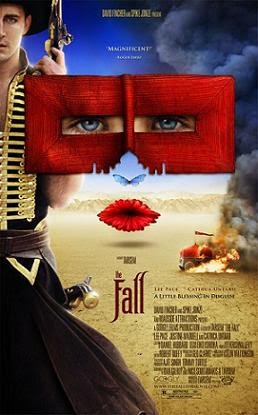
The Fall


To what can one compare this film, one of the most magical I've seen in quite a while? Think The Princess Bride meets Moulin Rouge meets The English Patient (at least its better aspects) and you might be halfway there. This unique and enthralling movie—filmed over four years, in twenty-eight countries and at the director’s own expense (because the concept was too crazy to attract a producer)—presents a very simple but moving story at its center, surrounded by a swirling pastiche of visual imagery: audacious costumes, butterflies that morph into islands, a mystical shaman emerges from a burning tree, endless labyrinths and mazes of Escher-esque staircases, a bus-sized wagon propelled by a small army of slaves, a priest’s grinning face and elaborate collar morph into a surrealist desert landscape. And what is more, if the director himself is to be believed, no computer generated effects were used in the film! He apparently has an uncanny gift for finding and exploiting some of the most obscure and overlooked locations for scenes which one would assume could only have been realized through digital sleight of hand, or through the construction of wildly elaborate sets that would give Ben-Hur a run for his money.

Following an opening sequence (effectively accompanied only by the haunting Allegretto from Beethoven’s Seventh Symphony) involving what we, after some puzzlement, discern to be a silent movie set where something has gone terribly wrong, the scene shifts to a Los Angeles hospital, apparently somewhere around 1920. Among the interesting cast of characters which constitute the hospital’s patients, caretakers and other employees are Roy Walker (Lee Pace), the stuntman who has apparently been paralyzed from the waist down in the accident depicted at the beginning, and Alexandria (Catinca Untaru), a young child of immigrant orchard workers, who is recovering from a broken arm. Though housed in different parts of the hospital, the two wind up meeting and, in what involves some clever twists on the classic theme, Roy plays Scheherazade to Alexandria’s Shahryar, whiling away their convalescent hours by weaving a tantalizing and epic adventure tale to her enthrallment.

It soon becomes apparent however that there is a dark ulterior motive behind his obvious gift for and enjoyment in storytelling: his desire to gain the girl’s unwitting assistance in his own suicide attempt. Alexandria, however, though teased into compliance by his strung-out fable, proves at once both too naïve and too clever for him. In a moving tribute to the power of narrative, Alexandria begins to insert herself into the story when she senses that Roy is faltering under the weight of his own despair, and, in a subsequent contest of wills, each in turn seeks to steer the plot toward alternately destructive or redemptive ends.

Some other miscellaneous tidbits and sub-themes we are treated to along the way include: Clever visual portrayals of cross-cultural and linguistic misunderstandings (Roy’s intended Native American “Indian” becomes an “Indian” from the subcontinent in Alexandria’s imagining.); A delightful exploration of the very fine line that exists between reality and imagination in the life of a child. (The scary x-ray technicians that Alexandria glimpses in the hospital’s dark corridors clearly inspire the villainous hordes of the fantasy world.); Religious symbolism, much of it specifically Christian, is interwoven here and there—some of it obvious and some of it more subtle. (Why, for instance, one might ask, is a worker shown cutting palm branches from high up in a tree during the initial shot of the hospital?)

For all the delightful excesses lavished upon the film, director Tarsem nonetheless shows remarkable gifts of restraint in this production just where it matters most. Most notably, the decision to keep the running time at just under two hours keeps the magic from souring into a tedious and self-indulgent sensory overload (à la Peter Jackson’s King Kong). And while there is a curse word or two and perhaps just enough violence and brutality to justify the R rating (though I’m sure I’ve seen worse in PG-13 films), there is none of the uber-bizarre, sexualized violence which (apparently—I haven’t seen it) marks his other film of note, The Cell. Lee Pace gives a really great performance, but Untaru’s performance is just splendid, thanks in large part to careful handling by both Tarsem and Pace. (This is illuminated, along with many other fascinating details, in the DVD Commentaries and Special Features, which are also well-worth watching.)

And finally, it has to be observed that the film’s difficulties in finding a distributor (it premiered in 2006 but wasn’t officially released until 2008) just testify once again to the debased cinematic establishment’s commitment to bland, mass-marketability over genuine creative merit. (Brings back to mind Kenneth Branaugh’s still yet-to-be-released The Magic Flute.)

Tuesday, April 13, 2010

Bright Star, Redux


Upon further reflection, I have come to realize that my initial reaction was rather off the mark and that I’m now going to have to eat some of my earlier words regarding this film. Not that I’m now going to praise it as one of the greatest films ever made, but it does have a certain charm which really grew on me in the days following my initial viewing, and which was further reaffirmed upon a second. I think this is one of those movies that has to be evaluated on its own terms, something I failed to consider in my first review, forgetting that not every film aspires to the same level—or even the same kind—of greatness.

To reiterate some of the picture’s more obvious strengths: exquisite cinematography, delightful costumes, and several first-rate performances. (Paul Schneider is particularly effective and fun to watch as Keats’ friend and patron, Charles Armitage Brown.) My first time around, I thought the score was decent but too sparse; now I realize that this was an exercise in studied and wise restraint, one which increases the potency of the scenes where the music does make an appearance. (Bonus points too for the unique a cappella arrangement of the Mozart wind serenade, which is featured prominently. Come to think of it, that may have been the subliminal trigger that caused me to make the Amadeus comparison in the first place.)

Certain almost incidental elements, such as the interactions between Fanny and her siblings, are likewise subtly endearing. It’s also striking and refreshing, especially given the Romantic context in which the film is set, to be so boldly confronted by the presentation of two lovers who, though stirred by the most intense passions and forces of attraction, nevertheless resolve to act honorably (in sharp contrast to Brown’s character, it should be noted), remembering that their actions will have consequences far beyond the present moment. (HT to Jeffrey Overstreet for this observation, and to Joe Thacker,for pointing me there.)

And lastly, I was very much remiss in failing to mention the absolutely fabulous and right-on-the-money quotation about the nature of poetry, given by Ben Whishaw in his role as Keats.

A poem needs understanding through the senses. The point of diving in a lake is not immediately to swim to the shore; it’s to be in the lake, to luxuriate in the sensation of water. You do not work the lake out. It is an experience beyond thought. Poetry soothes and emboldens the soul to accept mystery.

So my reconsidered take on this film is to approach it much on these terms. This is not a fast food flick; it’s a leisurely four course meal kind of movie. Watch it being prepared for a somewhat slower-than-normal pace, and without expecting any huge surprises—no innovative plot twists, or grandiose commentaries on the human condition. This is not one of those films which, as Keats also says of certain men at one point in the dialogue, aim to "make you start without making you feel". Be prepared, rather, to luxuriate in the sensation which each progressive scene conjures up, and I think you will find the experience a most enjoyable one.

Saturday, March 27, 2010

Bright Star


Though definitely worth watching, this biographical sketch of the great Romantic poet John Keats’ final years proves rather disappointing overall. The film follows the relationship of Keats and his fiancé Fanny Brawne, which ends in tragic and unconsummated separation due to Keats’ poverty, failing health and untimely death from tuberculosis in Rome at the age of twenty-five. Despite some excellent casting choices, admirable performances and beautiful camera work, the overall result still somehow manages to engender a tedium which seems to overflow the otherwise reasonable limitations of the hour-and-fifty-nine-minute time-frame. Quite unlike Keats’ poetry, there is simply little here to arouse the imagination or draw the audience in so that they may themselves experience and become participants of both the elation and the pathos of the work that is set before them. For this failure, I think the screenplay itself is mostly at fault.

More specifically, I think this is a case where a too conservative approach—one that resolves, on the whole, to stick safely to the known biographical facts—ultimately fails to satisfactorily meet the demands of the chosen medium. A narrative film needs to accept and embrace the fact that it is not a documentary. By contrast, an approach which is willing to introduce some creative and well-considered, but not cheap or gimmicky, dramatical devices in order to better serve the narrative is much more successful. In addition to the other necessary qualities, this is what makes Amadeus, for instance, not a great biography (it reduces Mozart to something of a caricature and substitutes wild conjecture for historical fact), but a truly great film, while Bright Star remains simply a mediocre one. Both biopics begin with the considerable challenge of presenting an artist who was the consummate practitioner of his craft, and whose premature demise is well known and anticipated by the audience beforehand. But through creative daring, Amadeus attains the cinematic status of a Mozart, while Bright Star remains just another Salieri.

NOTE: Be sure to read my follow-up to this review here.

Monday, December 21, 2009

What’d I Say?


Finally got around to watching Ray (2004) this weekend, thanks to Netflix. (I know, I am way behind.) Loved the music, of course. (My maternal grandmother had some Ray Charles LPs which I got turned onto sometime in my early teens. They’ve passed down to me and still get spun with regularity on my studio turntable.) And I really appreciated the nice graphic vignettes that are sprinkled throughout. (It’s so inspiring to see graphic design being employed in movies in the digital age in ways that just weren’t feasible or even possible in earlier days.) There are some great performances here, some interesting (sometimes painful) character development going on, and some really nice dramatic touches throughout. In particular, I thought the theme of blindness was handled with artfully balanced sensitivity—it was certainly prominent, but not played up to the point of becoming all-consuming, as it might have been. (Incidentally, I’ve always been struck by how often the lyrics in Ray’s songs employ the idea of seeing…see the girl with the red dress on?…I can see that far away look in your eyes…still in peaceful dreams I see…you are my sunshine, etc. Also, a somewhat random observation: isn’t it rather strange how many famous musicians—Ray Charles, Johnny Cash, Elvis Presley—have been haunted by dead siblings?) On a more sobering note, without getting too raunchy or debased (PG-13), the film offers a straight-up portrayal of the uglier side of Mr. Charles’ sin-riddled double life—the kind of in-your-face negative example which is helpful for husbands and fathers to be confronted with from time to time.

Saturday, June 27, 2009

The Last Emperor


My wife and I re-watched this Best Picture Award winner (1987) together last night. For those unfamiliar, the film is a biopic about the last Chinese Emperor, Puyi, who assumed the throne in 1908 at just under three years of age, and lived (in deposed obscurity) well into the Communist era.

First, there are a few things I don’t like about this movie. Whether this reflects some personal bias on the part of the film’s director and/or producer or represents a sort of compromise which was necessary in order to secure and retain the good graces of the Chinese government (which made the astonishing allowance for the movie to be shot in the Forbidden City) I couldn’t say, but there is a subtle yet definite attempt to tug the viewer’s sympathies in the direction of the Communists. The manifold cruelties and atrocities perpetrated by the Reds are conveniently ignored or somehow painted quite benignly for the most part, while those of others (the Japanese) are not. Most notably, the warden of the Communist prison is portrayed sympathetically as a stern yet essentially kind-hearted individual interested in genuine “reform”. (Incidentally, my dad has travelled extensively in China and was actually in the train station in Harbin, which is featured in the opening scene, right around the time of the filming. I was discussing this with him today and he concurred with the above assessment, while offering further insight into some of the political intrigue alluded to in the film.) There are some scenes of decadence that, despite restrained handling, are a bit hard to watch and this fact, taken in light of the film’s 164 minute overall length, does create a bit of a drag in the latter half.

Be all that as it may, the movie certainly didn’t win nine Academy Awards for nothing. It is a very moving drama, full of very deep ironies which provide much meditative fodder on how much the world can change within just one lifespan. It is gorgeously shot and boasts perhaps the most stunningly beautiful opening credit sequence that I know of—a graphic designer’s garden of delights. (I have access only to an old VHS edition and am wondering if any of the recent DVD or BluRay releases include any special features which highlight this aspect of the production?) The score is delightful (some of it composed by David Byrne of Talking Heads fame), and, while the storyline is decidedly un-redemptive, there is nonetheless a very touching stroke of magic in the final scene which amply rewards the viewer’s willingness to endure the more tedious stretches of the film’s middle portion. All told, it exemplifies the cinematic medium in that it tells the story primarily by showing the story, in graphic images which leave an indelibly rich impression upon the audience’s psyche.

One final, personal tidbit. I have long admired the font (Carlton) which is used for the main title, and have employed it myself, both in the masthead for this blog and in my own company logo.

Saturday, May 9, 2009

Mozart + Branagh = Pure Magic!


So I watched the whole thing on YouTube last night and my initial enthusiasm was confirmed – and then some! This really is a delightful film and a wonderfully fresh adaptation of Mozart’s great opera, The Magic Flute. If you are a fan either of Mozart or of Branagh (and who shouldn’t be?) you really should check this out. The production has strong echos of Moulin Rouge, despite being decidedly less dark overall. (And of course the music is superior!) Branagh has received some criticism for a few of the casting choices, but I really don’t find fault with anyone; I think most are really superb in their respective roles. My only complaint is that the discernability of the lyrics is rather inconsistent, especially with the choruses and ensembles. But that just sort of goes with the territory of opera and doesn’t really present much of a problem – you pretty much get what is going on anyway. If you watch on YouTube, follow the posts by operafan1975. They are numbered sequentially (Overture, Act 1.1, 1.2, etc.) and pretty easy to follow. Also might not hurt to read a short synopsis of the libretto, if you’re unfamiliar.

Let me mention one specific thing which I find intriguing about this production. Mozart, as many are perhaps aware, was a devoted follower of Freemasonry, and this opera was originally conceived as an embodiment of Masonic beliefs and ideals. (Mozart composed the music and his friend and fellow Freemason Emanuel Shikaneder wrote the libretto and also performed the part of Papageno in the first performances.) What this amounts to, in the original version, is a rather thickly spread adoration of Enlightenment rationalism on the one hand and the infusion of a good deal of quasi-pagan mumbo-jumbo on the other, both of which have always made this opera rather off-putting for me. But in this adaptation both of those aspects (especially the second) are considerably downplayed and there has even been a subtle but effective replacement of much of the original symbolism and language with that which is more explicitly Christian. All very interesting and rather surprising. I can’t say what Mozart and Shikaneder would have to say about it, but I’m delighted that Branagh opted to give it that delicate fine-tuning. As a result, the gospel, latent in virtually all myths and fairy tales, shines forth in this work with even greater clarity.

This is one I’d like to own (to say nothing of simply being able to watch in greater clarity!), and I really hope it is available in the U.S. soon.

Friday, May 8, 2009

Where’s Branagh’s Magic Flute?


I was not even aware (until I stumbled across it on YouTube) that celebrated Shakespearean interpreter Kenneth Branagh has produced an English film adaptation of Mozart's opera The Magic Flute. I’ve watched the trailer, opening sequence and some snippets from the rest and I am sold! The World War I-ish re-imagining of the rather bizarre and fantastical singspiel seems to work delightfully in Branagh’s creative hands. But here’s the kicker: looks like you’ll have no other option – no realistically viable one for the foreseeable future, anyway – than to watch as much of it as you can on YouTube. (A far less than ideal choice for a number of reasons, but what’s a fellow to do?) The film is going on three years old, but despite modest critical acclaim elsewhere it is not available for distribution in any form in the U.S. To paraphrase this L.A. Times writer, “What’s up with that?!”